
Zlom San Andreas: Understanding the San Andreas Fault and Its Impact
The term Zlom San Andreas refers to the well-known geological fault line called the San Andreas Fault. This massive fault runs through the U.S. state of California and is one of the most studied fault systems in the world. Scientists closely monitor this fault because it is responsible for many earthquakes in the region.
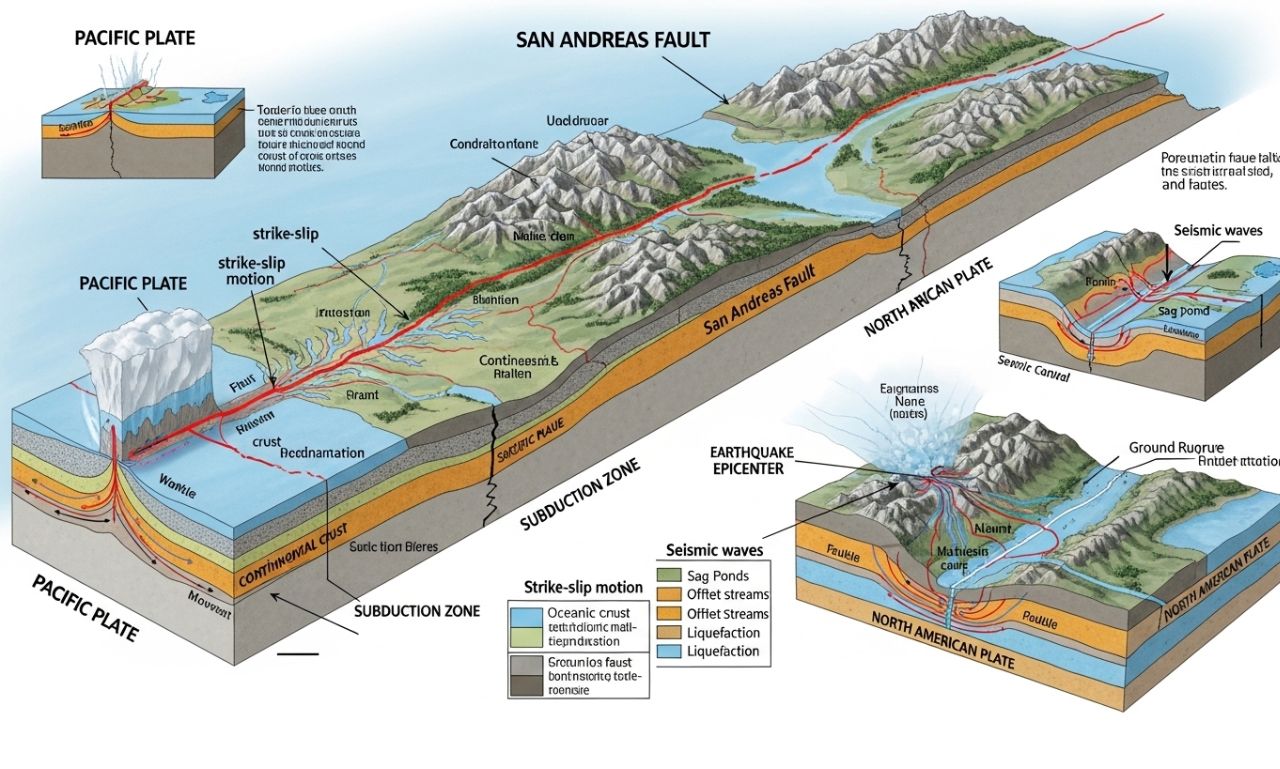
The Zlom San Andreas stretches for about 1,200 kilometers (750 miles) and marks the boundary between two major tectonic plates: the Pacific Plate and the North American Plate. Because these plates slowly move past each other, pressure builds up over time, which can lead to earthquakes.
In this article, we will explore what Zlom San Andreas is, how it formed, why it causes earthquakes, and its importance in geology and disaster preparedness.
What Is Zlom San Andreas?
The phrase Zlom San Andre as translates to “San Andreas Fault.” A fault is a crack or fracture in the Earth’s crust where tectonic plates move relative to each other.
The San Andreas Fault is a transform fault, meaning the two plates slide horizontally past one another rather than moving apart or colliding.
This movement is extremely slow—usually only a few centimeters per year—but over time the accumulated pressure can suddenly release, causing earthquakes.
Location of Zlom San Andreas
The Zlom San An dreas runs through a large portion of California.
It stretches from:
-
Northern California near San Francisco
-
Through central California
-
Down toward Los Angeles
-
Ending near the Salton Sea
Because many large cities are located near this fault line, earthquakes in the area can affect millions of people.
How the San Andreas Fault Was Formed
The Zlom San Andreas formed millions of years ago due to the movement of Earth’s tectonic plates.
The Pacific Plate moves northwest relative to the North American Plate. Over time, this movement created a long fracture across California.
This type of fault is known as a strike-slip fault, where two blocks of the Earth’s crust slide past each other horizontally.
Scientists estimate that the plates move approximately 5 centimeters per year, but the movement is not always smooth. Instead, pressure builds up until it is suddenly released in an earthquake.
Major Earthquakes Related to Zlom San Andreas
Several historic earthquakes have been linked to the Zlom San And reas.
1906 San Francisco Earthquake
One of the most famous earthquakes occurred in 1906 near San Francisco.
This disaster caused massive destruction and fires that devastated much of the city.
Key facts:
-
Magnitude: about 7.9
-
Thousands of buildings destroyed
-
Thousands of people killed
This event helped scientists better understand the behavior of the San Andreas Fault.
Earthquake Risk Near Zlom San Andreas
Because the Zlom San And reas runs close to major population centers, scientists closely monitor its activity.
Cities such as:
-
Los Angeles
-
San Francisco
are located near the fault system, making earthquake preparedness extremely important.
Geologists warn that a large earthquake—sometimes referred to as the “Big One”—could occur in the future if enough pressure builds along the fault.
How Scientists Study the San Andreas Fault
Researchers use advanced technology to monitor the Zlom San An dreas.
Common methods include:
Seismographs
These instruments detect vibrations in the Earth’s crust and help track earthquake activity.
GPS Monitoring
GPS systems measure the movement of tectonic plates with high precision.
Geological Surveys
Scientists study rock formations and fault patterns to understand the history of earthquakes along the fault line.
These methods help improve earthquake prediction models and safety planning.
Why Zlom San Andreas Is Important
The Zlom San And reas is extremely important for both scientific research and public safety.
Geological Research
It provides valuable insight into how tectonic plates interact.
Disaster Preparedness
Understanding the fault helps governments prepare emergency response plans.
Urban Planning
Cities near the fault must design buildings that can withstand earthquakes.
Because of its size and activity, the San Andreas Fault remains one of the most studied geological features on Earth.
Interesting Facts About Zlom San Andreas
Here are some fascinating facts about the Zlo m San And reas:
-
It is over 750 miles long.
-
The fault moves about 2 inches per year.
-
Parts of the fault are visible on the Earth’s surface.
-
Some areas move slowly without causing earthquakes, a process known as “fault creep.”
These features make it a unique and important natural structure.
Final Thoughts
The Zlom San Andreas, also known as the San Andreas Fault, is one of the most famous geological fault lines in the world. Located in California, it marks the boundary between the Pacific Plate and the North American Plate.
Because the plates constantly move past each other, the region experiences frequent seismic activity. This makes the fault an important focus of scientific research and disaster preparedness efforts.
Understanding the Zlo m Sa n Andr eas helps scientists learn more about earthquakes and allows communities in California to better prepare for future seismic events.