
SFMCompile: What It Is, How It Works, and Why It Matters in Source Filmmaker
The term sfmcompile is a fundamental command for anyone working with Source Filmmaker (SFM), Valve’s powerful animation tool. When creating or rendering scenes, animators and editors must understand sfmcompile because it’s the process that generates final motion data, bakes animation layers, and compiles physics into usable formats. This article explores what sfmcompile does, how it works, common workflows that use sfmcompile, and practical tips for making the most of this feature without encountering errors.
What Is SFMCompile?
Defining sfmcompile
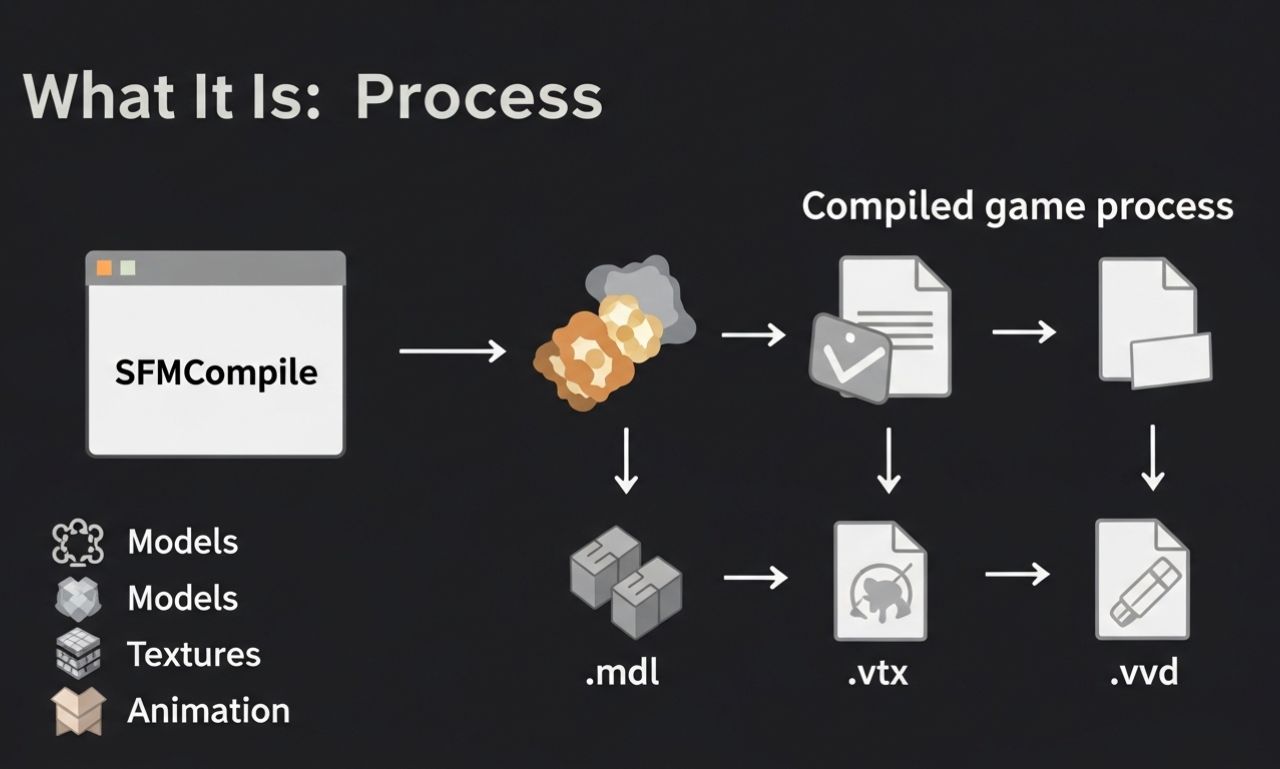
At its core, sfmcompile is a command‑line utility used within Source Filmmaker that compiles animation data before rendering. Rather than working directly with raw motion clips, SFM uses the sfmcompile process to transform animation layers — including keyframes, procedural motion, and constraints — into a format the render engine can accurately process.
When beginners start using SFM, they often ask, “Why won’t my animation play back or render?” In many cases, the answer lies in how sfmcompile processes, structures, and finalizes animation sequences internally before rendering.
How SFMCompile Works
Animation Composition and sfmcompile
Before the sfmcompile step begins, animators build scenes, place models, set keyframes, and build animation sets. Each element includes transforms, expressions, and sequencing. When a creator is ready to render, SFM takes all these separate components and runs sfmcompile to:
-
Flatten animation layers
-
Resolve motion conflicts
-
Bake animation into curves
-
Generate physics interactions
-
Prepare final scene data
This compiled result is what the Source Filmmaker renderer uses to produce frames. Without sfmcompile, the animation engine could not interpret the final motion.
Why SFMCompile Matters
Ensuring Accurate Rendering
The reason that sfmcompile exists is simple: it ensures animated scenes behave consistently once motion data is finalized. Because Source Filmmaker supports layered animation, constraints, puppeteering, and procedural physics, final motion can be incredibly complex. The job of sfmcompile is to resolve all of that into a coherent dataset that represents exactly what an animator intended.
Reducing Playback Issues
When users see glitches during playback — objects snapping, motion popping, or physics appearing unstable — it often traces back to incomplete or improper compilation. By understanding sfmcompile and running it intentionally after builds, animators avoid a range of interpretive errors.
When to Use SFMCompile
Before Rendering Movies
In Source Filmmaker, you always want to ensure sfmco mpile has been run before you start rendering your final movie or sequence. If you have multiple tracks, constrained objects, or expressions driving animation, sfm compile consolidates them.
After Major Animation Changes
Every time you make substantial edits — especially involving motion layers, IK rigs, or constraints — running sfmc ompile ensures your animation timeline reflects the final result you will render.
How to Run SFMCompile
Via the Console
In SFM, you can open the console (usually ~) and enter:
This forces the animation system to compile all current layers. Once complete, you’ll receive a feedback message confirming success.
During Job Submission
If you use the File → Submit workflow to queue movies for rendering, SFM automatically runs sfmc ompile internally before sending the job. However, manual execution helps ensure that no unexpected changes occurred since the last export.
Common SFMCompile Errors and Solutions
Animation Not Updating After Edits
If your scene doesn’t reflect recent changes, run sfmco mpile manually. Sometimes the internal compiler lags or doesn’t refresh updated layers.
Missing or Jumping Motion
When the animation appears to jump or reset mid‑timeline, it often means a keyframe conflict exists. Running sfm compile after resolving conflicts will fix these anomalies.
Errors in the Console
When you see console warnings during sfm compile — like invalid channels or unresolved expressions — it points to broken tracks or unsupported animation constructs. Review your timeline, remove problematic keys, and run sfmc ompile again.
Best Practices for Using SFMCompile
Save Before Compiling
Always save your session before running sfm compile. This ensures that if any unexpected behavior occurs, you can revert.
Clean Up Your Timeline
Remove unused tracks or disconnected keyframes before compilation. A cleaner timeline reduces errors and improves performance.
Break Long Sequences into Shots
For larger projects, split sequences into shorter shots before running sfm compile. This minimizes memory load and improves render stability.
SFMCompile and Performance
Compilation Time vs Complexity
The time it takes to run sfm compile depends on scene complexity:
-
Simple scenes with few models compile quickly.
-
Complex shots with physics simulations, puppeteering, and lighting rigs can take longer.
Understanding this helps creators manage their workflow and avoid unnecessary delays.
Advanced Tips for SFMCompile Users
Use Scripts for Bulk Jobs
If your project has many animated sequences, scripts can batch run sfm compile across them, saving time.
Check Animation Set Details
Before compiling, verify every animation set (models, cameras, props) has valid keyframes. Broken or orphaned sets often cause compile warnings.
Work Incrementally
Compile frequently during heavy editing. This lets you catch issues earlier rather than at the final render stage.
SFMCompile vs Source Engine Compilation
It’s worth noting that sfm compile differs from source engine content compilation (e.g., compiling maps in Hammer Editor). While both share a name, sfm compile focuses specifically on animation data within Source Filmmaker, not world geometry or map brushes.
Some users confused by the terminology come from other Valve tools where “compile” refers to building BSP maps or shaders. In SFM, it’s strictly animation and motion data.
Examples of SFMCompile in Workflow
Simple Walk Cycle
An animator builds a walk cycle using keyframes and constraints. Before rendering:
-
Open console
-
Enter sfm compile
-
Verify motion in shot browser
-
Queue render job
Complex Cutscene With Props and Physics
For a cinematic involving ragdoll physics and moving props:
-
Assemble scene
-
Apply constraints
-
Test playback
-
Run sfm compile
-
Resolve warnings
-
Submit render
In both scenarios, sfm compile ensures the compiler bakes all elements into the final dataset.
Conclusion
Understanding sfmcomp ile is essential for anyone working in Source Filmmaker. Whether you are a beginner or an experienced animator, knowing how sfmc ompile works — when to run it, why it matters, and how to solve common issues — will dramatically improve your workflow and final results. From flattening layered animation to resolving motion conflicts and preparing scenes for rendering, sfm compile is a central piece of the Source Filmmaker ecosystem. Mastering it will help you produce smoother animations, more reliable renders, and fewer workflow frustrations.